Five windows into where interference with transmission is manifesting.
“Lesson 2.3. The HARD Way Heat Maps: Five Views to the Brainstem.”
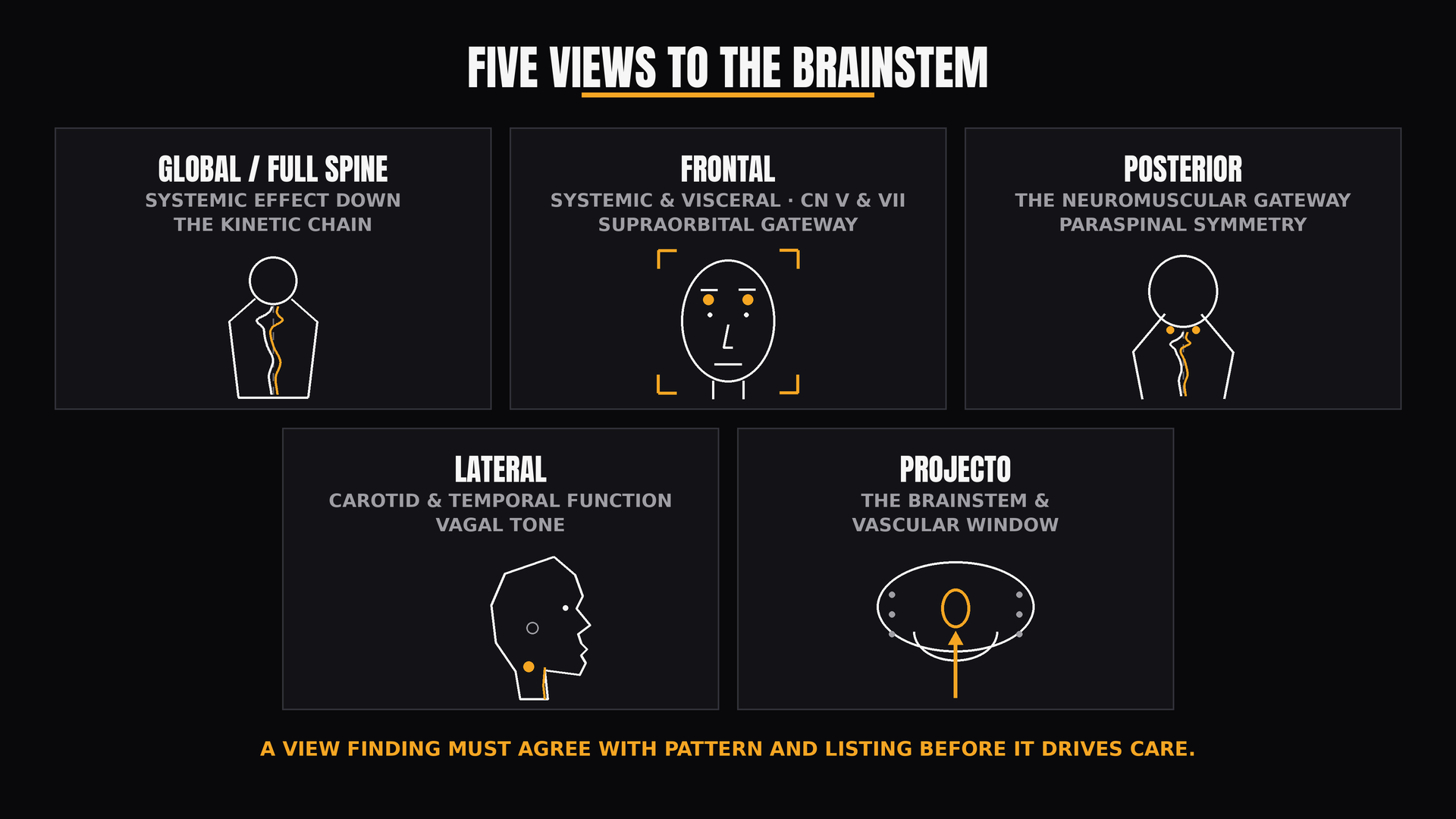
The five thermogram views — Global/Full Spine, Frontal, Posterior, Lateral, Projecto — each a different window into where “Interference with Transmission” (Principle #31) is manifesting. Together they form the Upper Cervical “Window to the Brainstem” assessment.
From the chapter — what each window shows, and what it reads.
Global Adaptive Stress and the systemic effect of an upper cervical subluxation traced down the kinetic chain (radicular and visceral involvement). Deviations from the gradual S2→C1 paraspinal gradient open the window into the sympathetic nervous system.
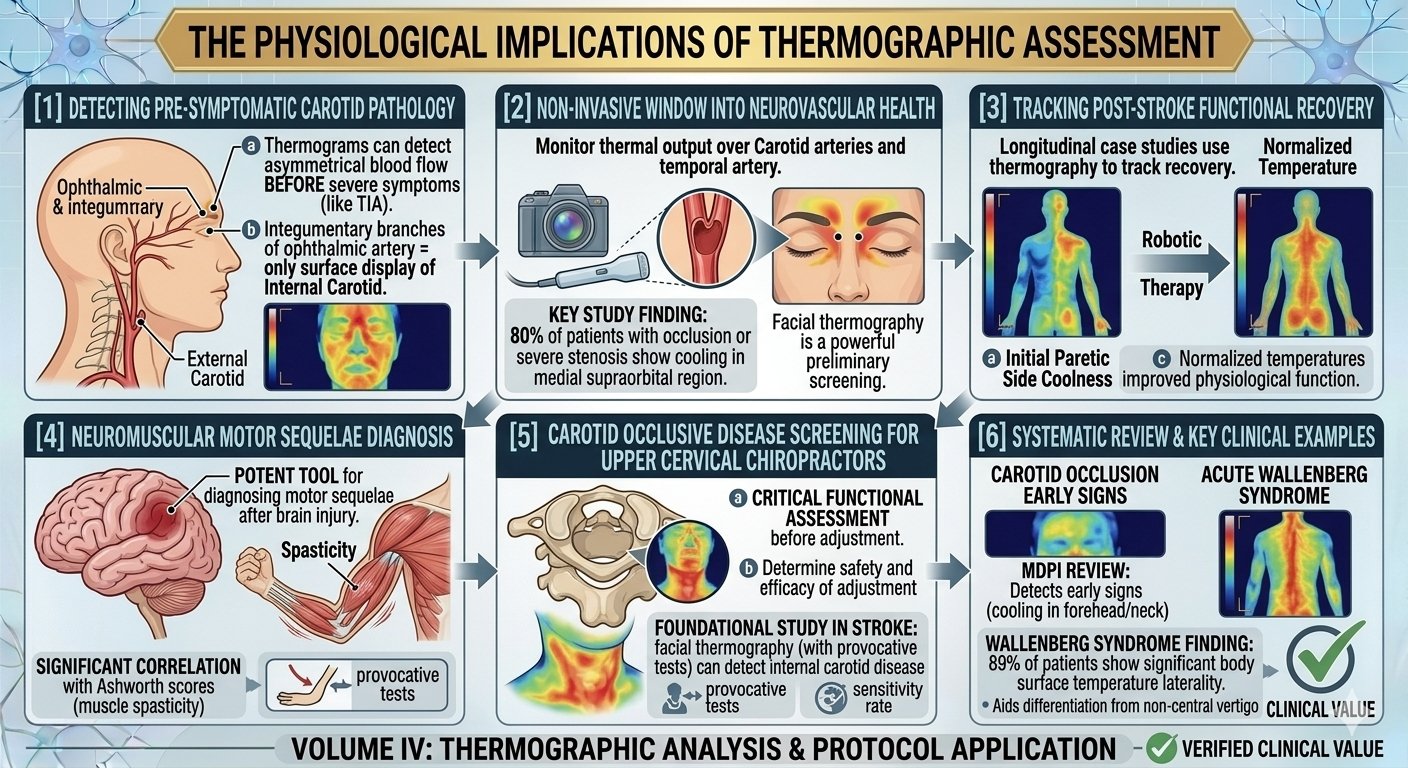
CN V & VII function, sinus and nasal perfusion. The supraorbital gateway reads cerebrovascular flow: in a landmark Stroke study, 80% of patients with significant carotid stenosis/occlusion showed a marked temperature drop over the medial supraorbital region (ophthalmic artery territory).
Paraspinal symmetry is the hallmark of neurological integrity; myotomal/dermatomal/ thermatomal mapping traces an “effect” back to its segmental “cause” (the 1999 Yonsei thermatomal study: ΔT beyond 0.1–0.3°C between sides is a statistically significant abnormality marker).
Carotid and temporal artery function; the vagus nerve (CN X) runs beside the atlas, so lateral views read vagal tone and global autonomic regulation; “cold” patterns differentiate trigeminal neuralgia and Bell's Palsy states of sympathetic distress.
Anterior C1 and the 23 Functions of the Brainstem; mandibular and scalene lymph distributions separate neurovascular congestion from lymphatic blockage secondary to neurological stress.
| View | Clinical Focus | Primary Indicators |
|---|---|---|
| Global & Full Spine | Global Adaptive Stress; the systemic effect traced down the kinetic chain | Deviations from the gradual S2→C1 paraspinal gradient |
| Frontal | Systemic & visceral impact; cerebrovascular flow at the supraorbital gateway | CN V & VII, supraorbital cooling |
| Posterior | The neuromuscular gateway; tracing an effect back to its segmental cause | Paraspinal symmetry, sub-occipital heat |
| Lateral | Carotid and temporal artery function; vagal tone and autonomic regulation | Carotid/temporal function, C1 inflammation |
| Projecto | The brainstem & vascular window; anterior C1 | Lymphatic distributions, drainage blockages |