Advanced HIO Toggle Recoil (Online) · Set 1 — Foundations

Lesson 1.1 — The Universal Principles & Autonomic Organization

The nervous system is the measurable expression of the principles.

← Lesson 0.5 — Meet Your Instructor · in production Back to the Course ↑ Lesson 1.2 — Anatomy of the Word & the Sympathetic Mirror →
Avatar Lesson Video — Render Ready, File Placement Pending

“Lesson 1.1. The Universal Principles and Autonomic Organization.”

The Lesson

This lesson traces the legacy of objective metrics — from the Neurocalometer (NCM) to modern digital infrared thermography (DITI) — and maps Stephenson's 33 Principles onto global autonomic tracking.

The 33 Principles as an operating system: Universal Intelligence, Innate Intelligence, and the Triune of Life (Intelligence, Force, Matter). Senzon (2010) framed the 33 as an integral “map” of reality — thermal scans are a map of human physiology drawn on the same territory.
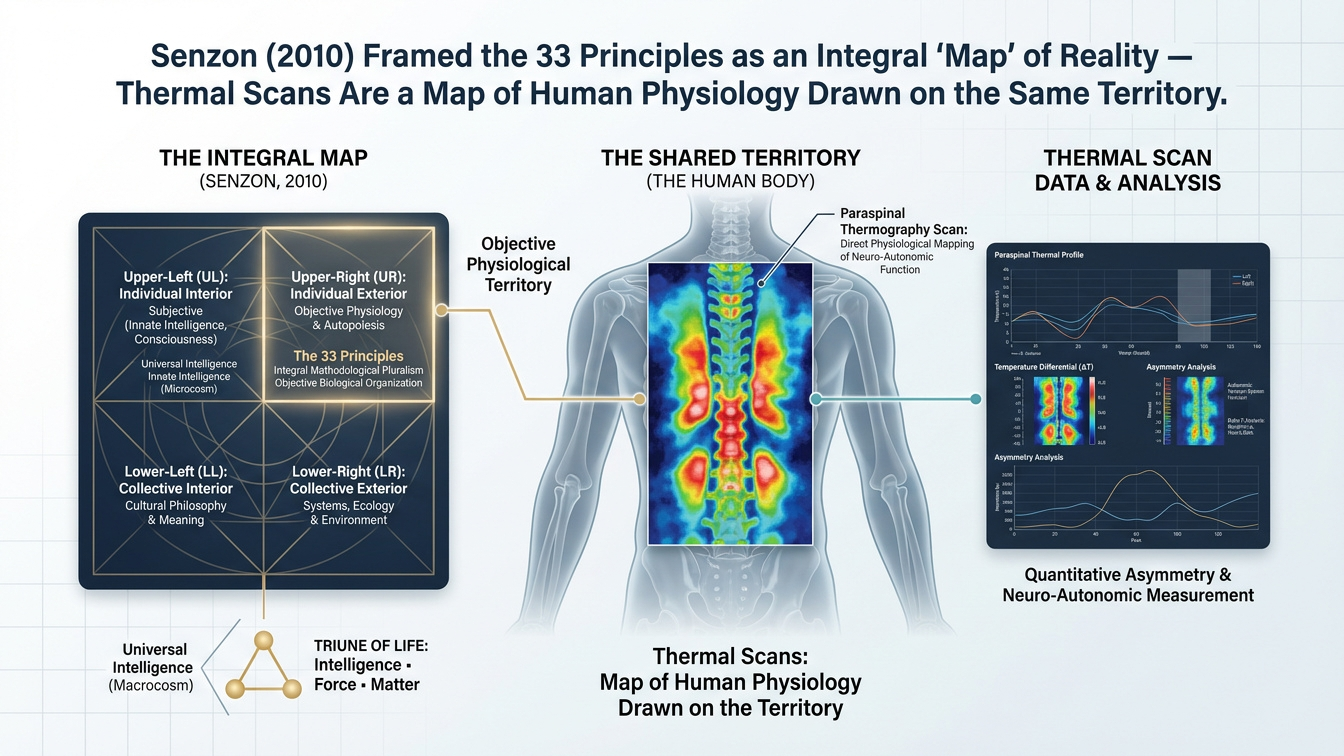
Diagram: Senzon's integral map of the 33 Principles on the left, the human body as the shared territory in the center with a paraspinal thermal scan, and thermal scan data and analysis on the right
Senzon (2010): the 33 Principles as an integral map of reality — thermal scans map human physiology on the same territory.

The Autonomic Organization

The nervous system is the measurable expression of the principles. The autonomic system — sympathetic and parasympathetic — runs the blood vessels. When interference hits that system, the vessels respond segment by segment, and the temperature of the skin over the spine changes with them. That is why heat is data: the autonomic organization is where the principles stop being philosophy and start being measurable.
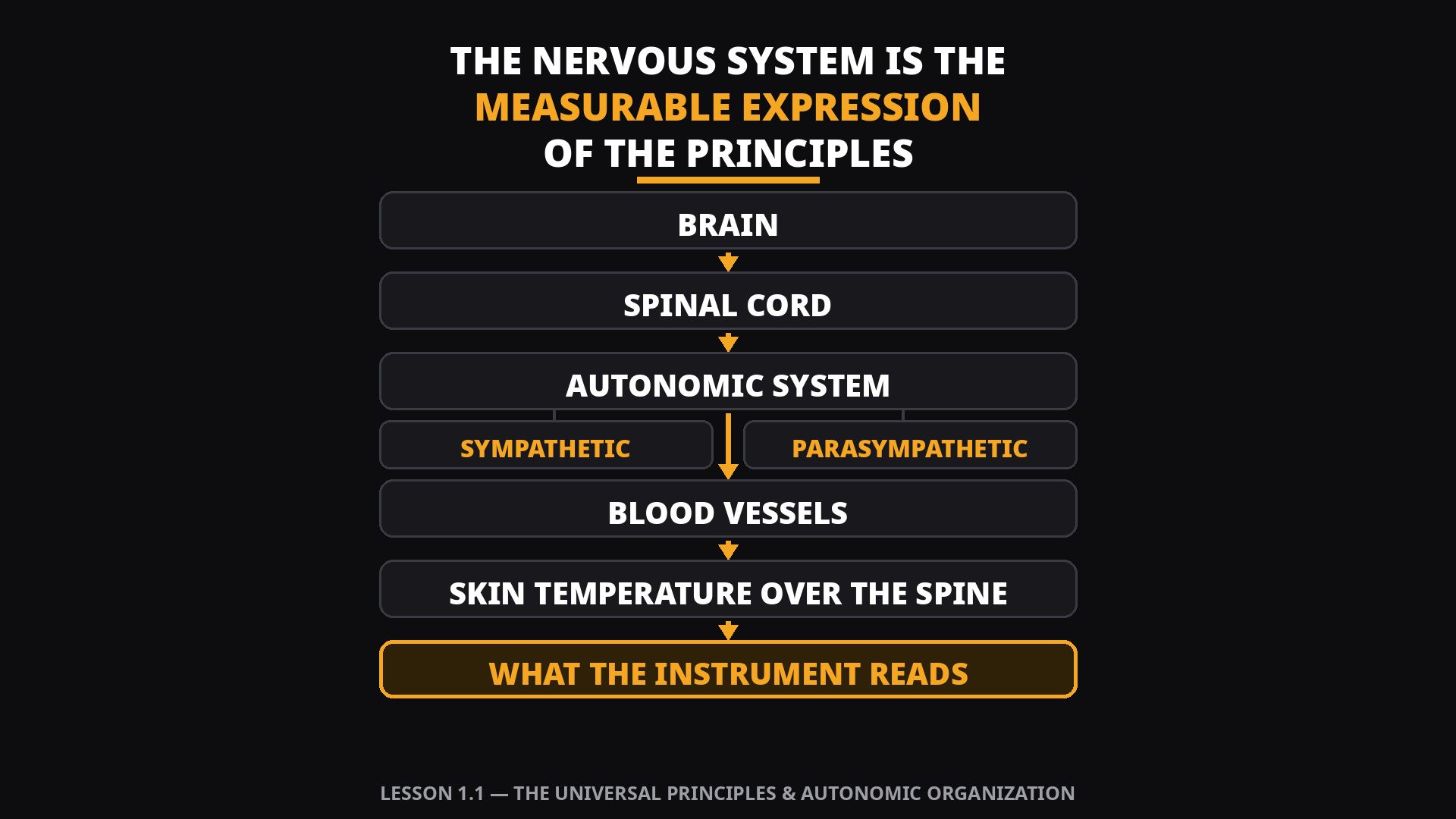
Flow diagram: brain to spinal cord to the autonomic system, sympathetic and parasympathetic branches, to blood vessels, to skin temperature over the spine, to what the instrument reads
The chain the instrument reads: brain → cord → autonomic system → vessels → skin temperature over the spine.

From Opinion to Instrumentation

Why B.J. Palmer and Dossa Evins built the NCM (1923–24): doctors were arguing from opinion — one pair of hands against another, with no way to settle it. The Neurocalometer was the turning point: subluxation analysis stopped being opinion and became instrumentation.
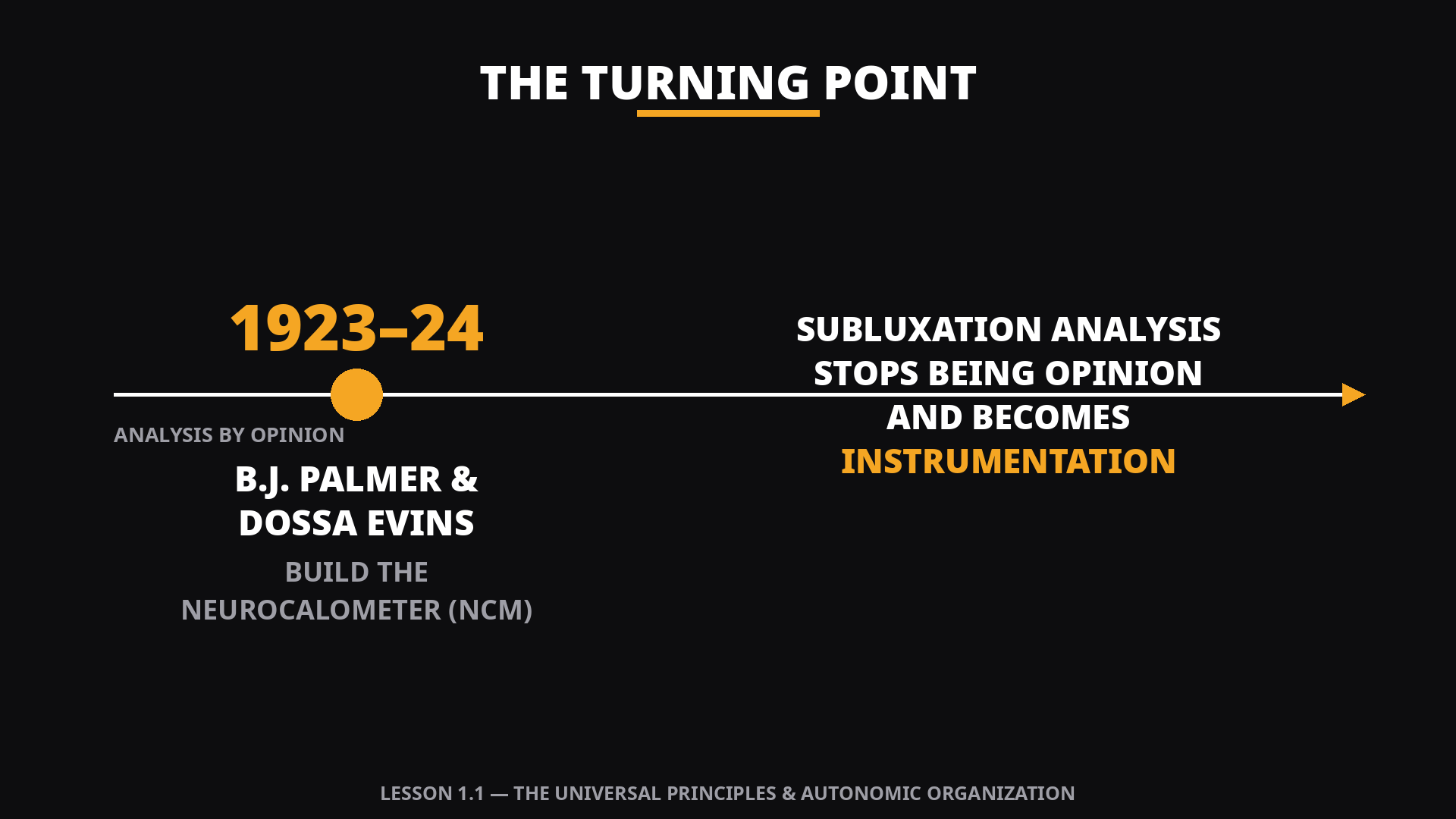
Timeline card: 1923–24, B.J. Palmer and Dossa Evins build the Neurocalometer — subluxation analysis stops being opinion and becomes instrumentation
1923–24: the Neurocalometer — the turning point from opinion to instrumentation.

Pattern Over Point-in-Time

A single reading is weather; a pattern is climate. One reading tells you almost nothing — the environment, mental state, medications, stimulants, and a hundred other things move it. A pattern — the same finding, scan after scan, visit after visit — is the climate of that nervous system, and the functional expression of the body's adaptation to subluxation. We never build a correction on weather. We study the climate until it speaks clearly. And we never adjust on one expression alone: we analyze, research, and diagnose the subluxation first — then we introduce a specific correction, so that Innate Intelligence may provide the necessary adjustment to the system.

On a TyTron-style scan the reading runs vertically, down the spine: the left and right traces are one overlapped reading traveling together, and the ΔT is the separation between the pair — widening at the break. The course standard: ΔT ≤ 0.30 °C is clear.

A break must match the pattern to be a subluxation. When a reading runs opposite to the pattern, that is not the same climate — it is a variable, and a variable is not a finding.
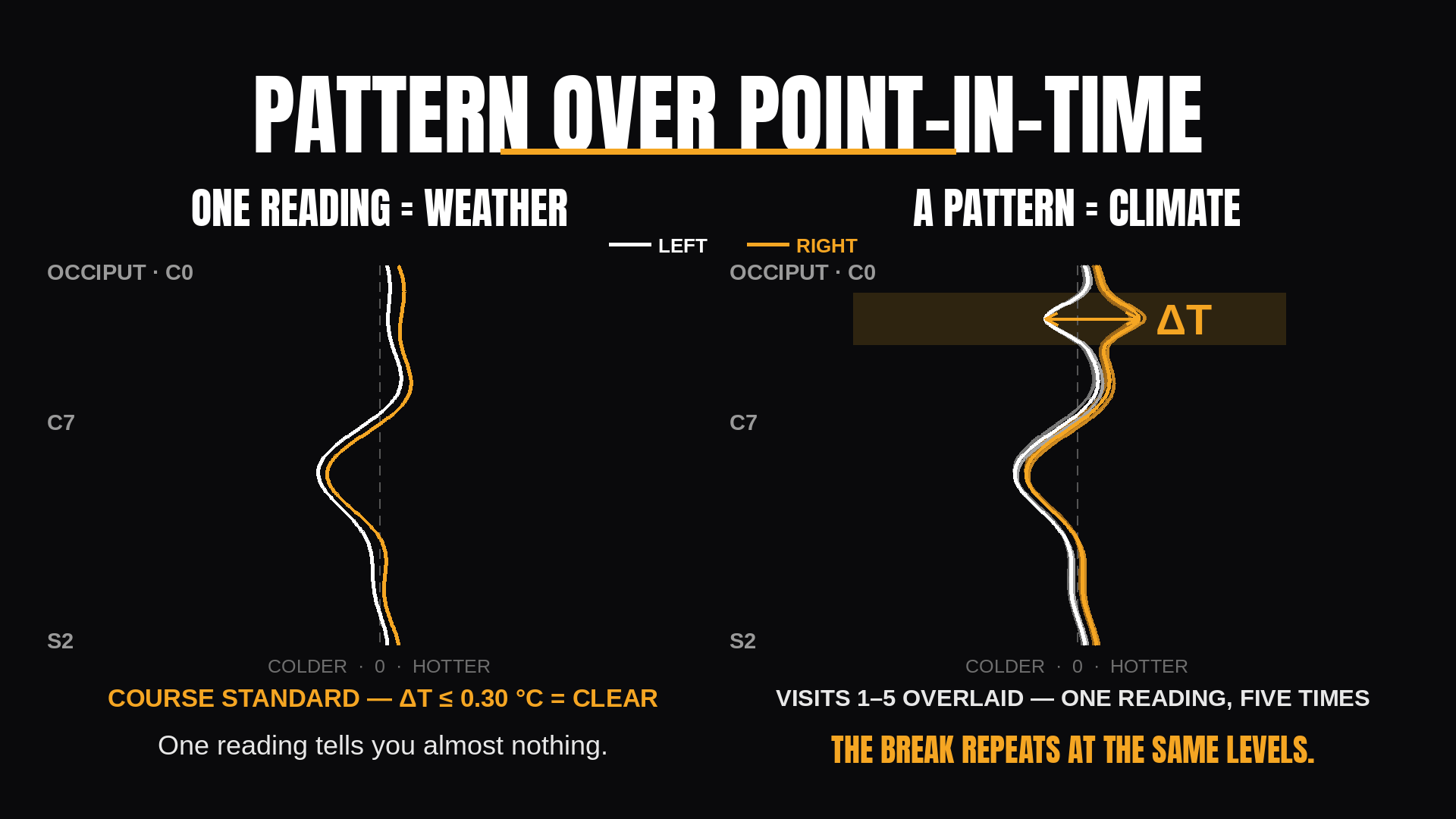
Two vertical TyTron-style line scans: one reading as weather, a single left-right trace pair traveling together down the spine; and a pattern as climate, the same overlapped pair repeated across five visits, the pair's separation widening at the same upper-cervical break level on every visit
One reading is weather. A pattern — the same overlapped reading, the break repeating at the same levels, visit after visit — is climate.

The Four Foundation Principles of Thermal Analysis

The four principles this entire course builds on.

  1. 6

    #6 — The Principle of Time

    “There is no process which does not require time.” Thermography tracks the process of adaptation, not a snapshot of position. A pattern identical over weeks means time has stood still for that nervous system. Non-invasive by nature: no radiation, no magnetic or sound fields.

  2. 11

    #11 — The Function of Intellect

    Innate Intelligence maintains the body in active organization. Thermal symmetry is active organization made visible; asymmetry is disorganization. We don't fix the heat — we remove the interference so Principle #11 restores organization.

  3. 18

    #18 — The Amount of Intelligence in Matter

    The evidence of Universal Intelligence is the adaptability of matter. We test thermal adaptability: a fixed scan that doesn't change with the environment is a system that has lost adaptability. The adjustment restores the ability to adapt.

  4. 31

    #31 — The Evidence of Interference (Subluxation)

    Interference with transmission is always directly or indirectly due to subluxations. This is the diagnostic standard for this course; Lesson 1.2 and all of Set 2 operationalize it.

Handout — Set 5, Lesson 5.8 The 33 Principles Clinical Assessment Map: every principle paired with the assessment that expresses it clinically — from the Global Thermal Gradient (#1) and HRV (#2) through the “Fixed” Thermal Pattern (#31) and the Paraspinal “Gutter” (#33). Discussion prompt: where does your current analysis rely on opinion instead of objective baselines?
Self-Check State, in one sentence each, how three of the 33 Principles show up as measurable autonomic data.
← Lesson 0.5 — Meet Your Instructor · in production Back to the Course ↑ Lesson 1.2 — Anatomy of the Word & the Sympathetic Mirror →