Advanced HIO Toggle Recoil (Online) · Set 1 — Foundations

Lesson 1.2 — Anatomy of the Word & the Sympathetic Mirror

The scan reads the system, not the symptom.

Avatar Lesson Video — Render Ready, File Placement Pending

“Lesson 1.2. The Anatomy of the Word, and the Sympathetic Mirror.”

The Lesson

Deconstructing sub-lux-ation — a physical state of “less light” — and the skin's capillary vasomotor system as the sympathetic mirror: where the word becomes something an instrument can read.

Anatomy of the Word

Sub = less, lux = light, ation = a state of: less expression of intelligence through matter. “Light” is the Mental Impulse — the expression of life-force from brain to body. The word itself carries the whole model: something that should be fully expressed is arriving diminished.
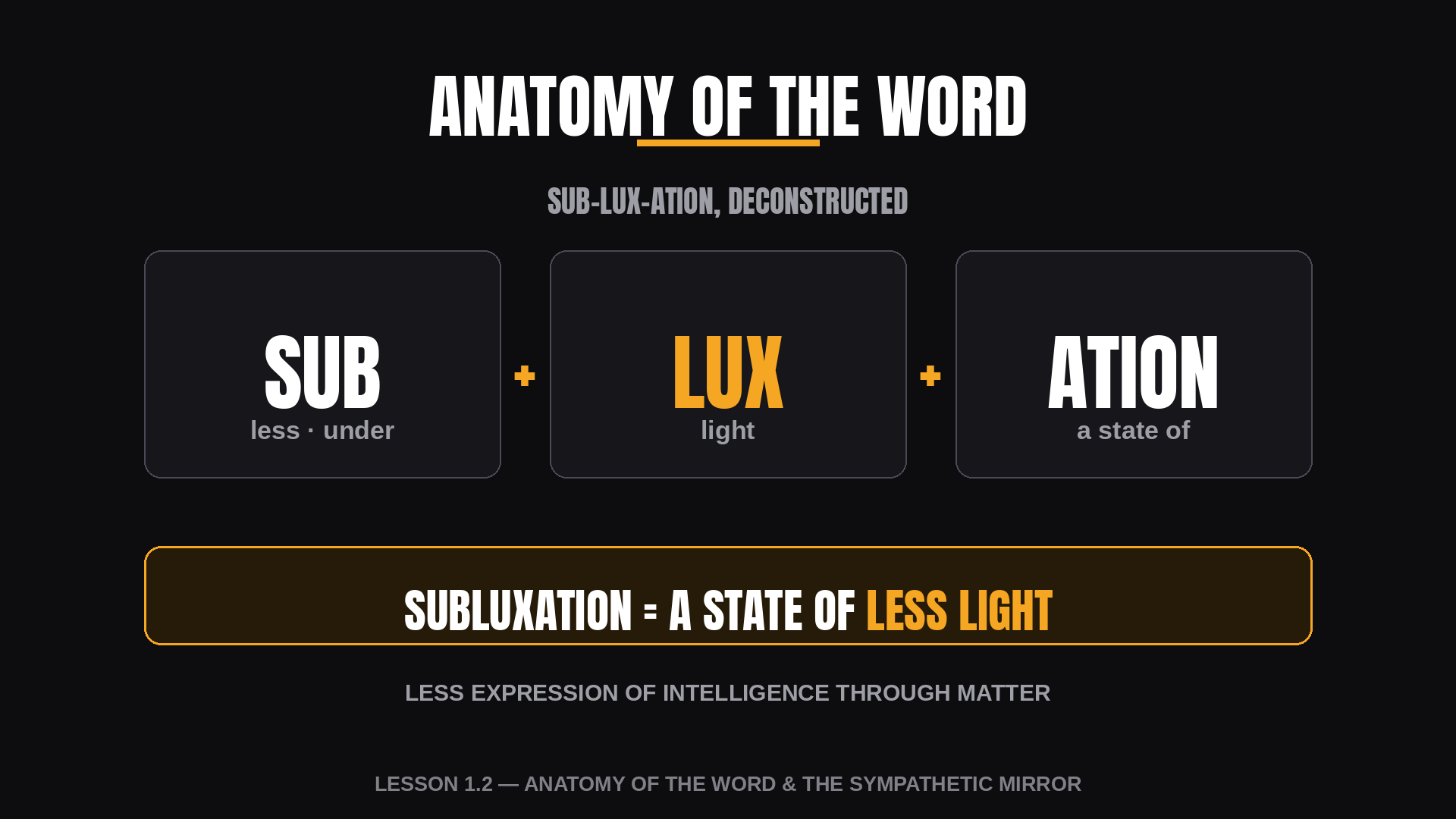
Three tiles assembling the word: SUB (less, under) plus LUX (light) plus ATION (a state of), resolving into the payoff bar: Subluxation = a state of less light
Sub + lux + ation: a state of less light — less expression of intelligence through matter.

Light Is the Mental Impulse

The Mental Impulse travels a defined pathway: brain, through the foramen magnum — the mouth of God, the gateway to heaven — past the atlas and axis, down the spinal cord, to the body. Where that pathway is interfered with, the expression dims: the same light, less of it getting through.

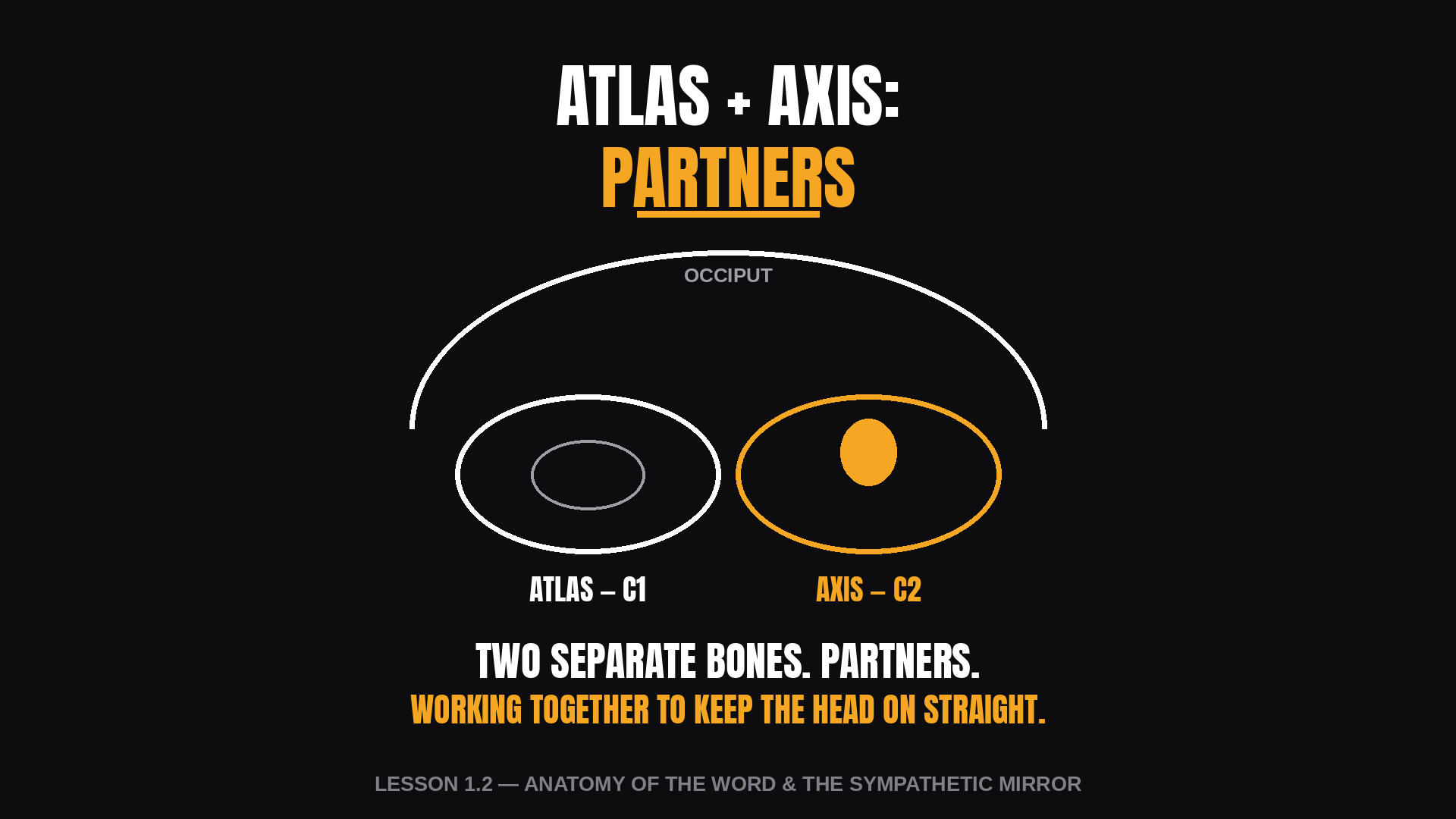
At the junction the impulse passes through two separate bones — the atlas and the axis — partners that must work together to keep the head on straight.
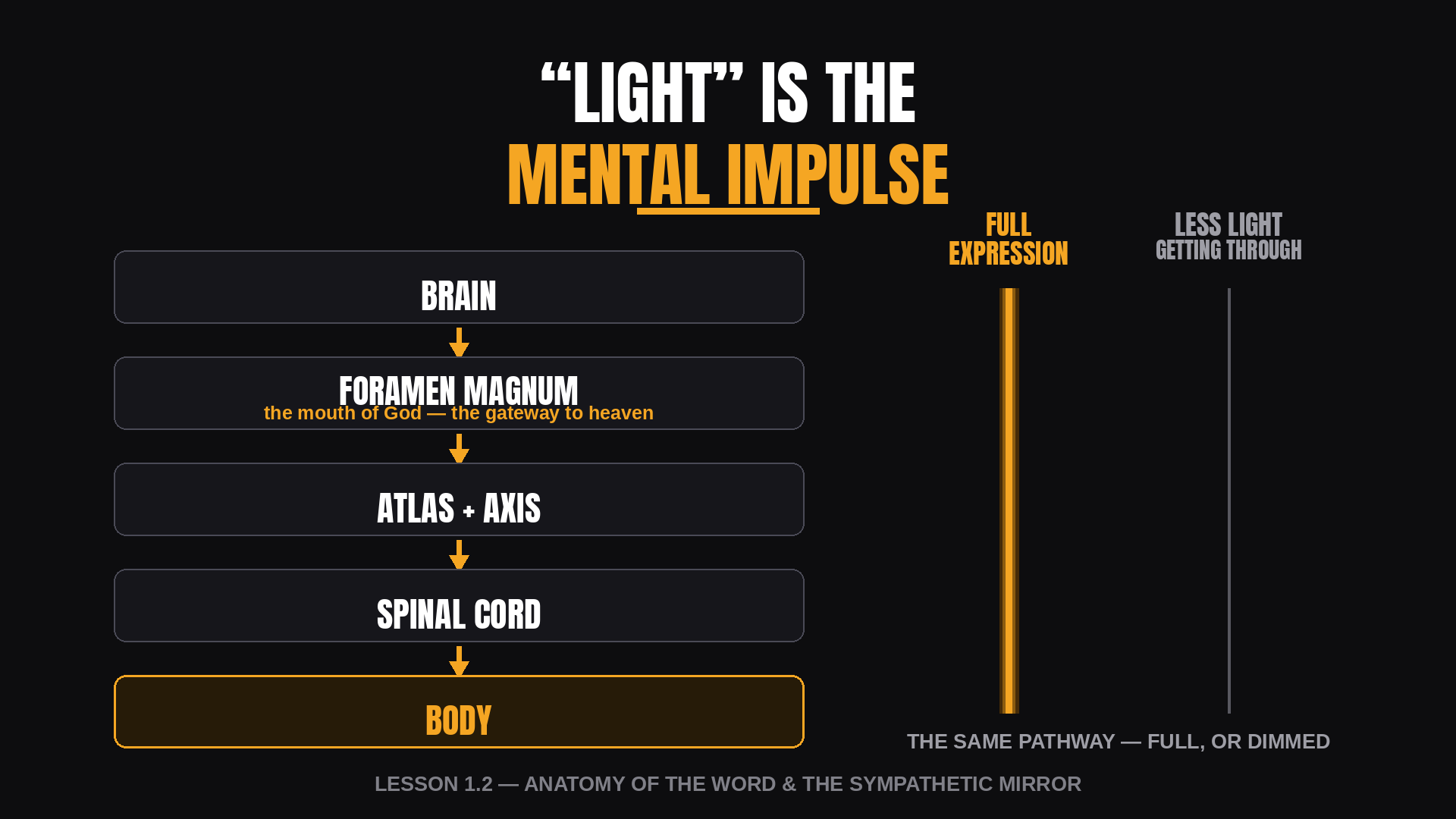
Flow diagram: brain to foramen magnum (the mouth of God — the gateway to heaven) to atlas and axis to spinal cord to body, beside two lines — a full-bright line labeled Full Expression and a dimmed line labeled Less Light Getting Through
The pathway of the Mental Impulse — and the dimmer: full expression, or less light getting through.
Schematic: the occiput above two separate top-down forms, the atlas (C1) and the axis (C2) with its dens — two separate bones, partners, working together to keep the head on straight
Atlas and axis: two separate bones. Partners. Working together to keep the head on straight.

The Sympathetic Mirror

Cutaneous capillary vasomotor fibers: sympathetic tone writes itself on the skin as temperature — the autonomic system controls capillary diameter, so brainstem interference shows up as abnormal, asymmetrical, or fixed thermal patterns. The skin is a mirror of the sympathetic system.

The mirror principle: the scan reads the system, not the symptom. If the impulse is clear, the scan shows homeostasis — thermal symmetry. A persistent locked pattern is the objective evidence the impulse is impeded.
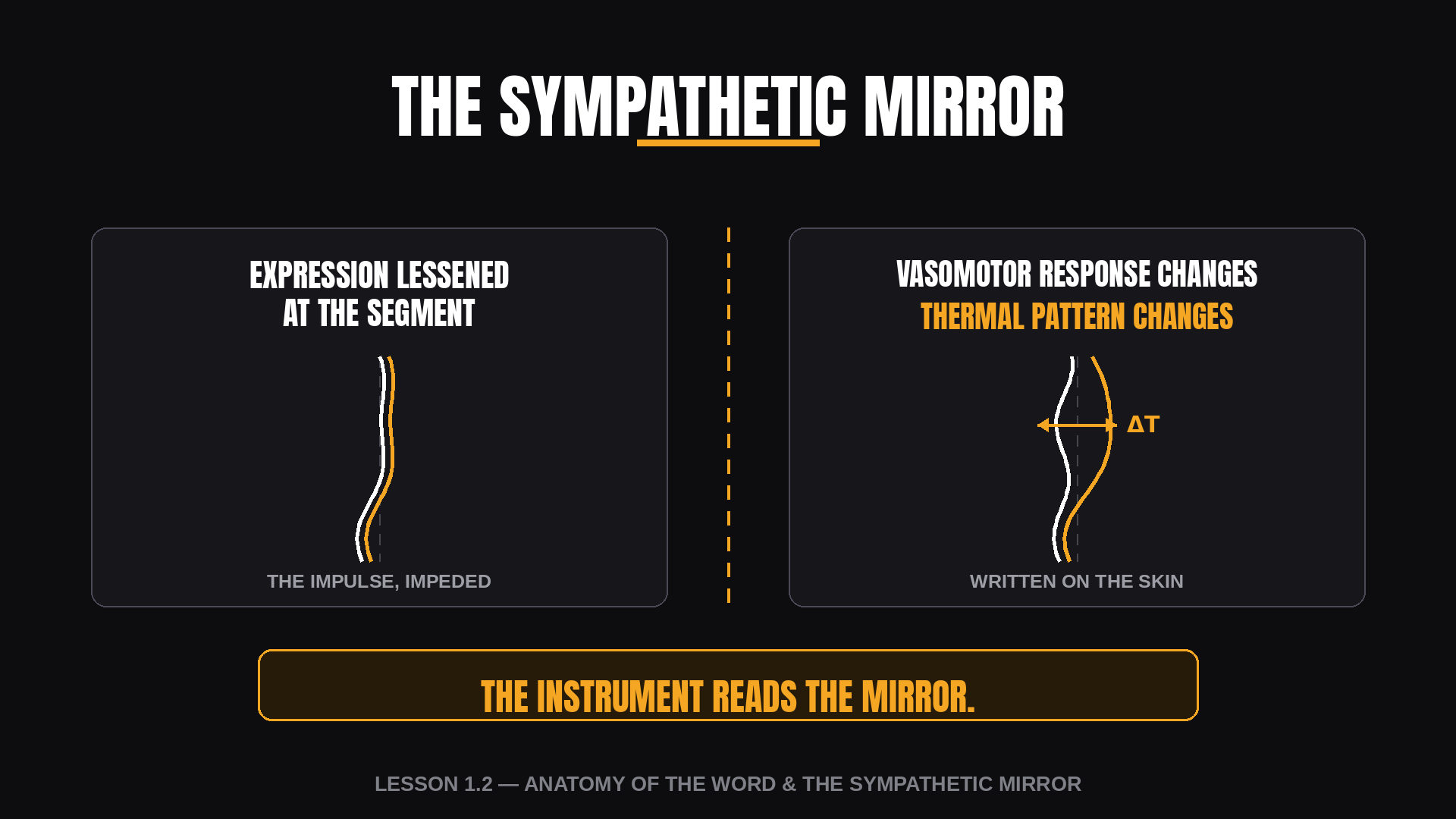
Two panels joined by a mirror line: expression lessened at the segment on the left; on the right, the vasomotor response changes and the thermal pattern changes, the overlapped left-right pair separating at the break with delta T marked — the instrument reads the mirror
Expression lessened at the segment; the vasomotor response — and the thermal pattern — changes with it.

Thermal Emissivity: Friction in the Line

An upper cervical subluxation creates a neurological bottleneck. Just as a wire heats where there is resistance in the line, the nervous system produces thermal emissivity as the byproduct of resistance to the mental impulse. DITI reads the infrared radiation (8–14 microns) emitted by the body — it reads the friction.
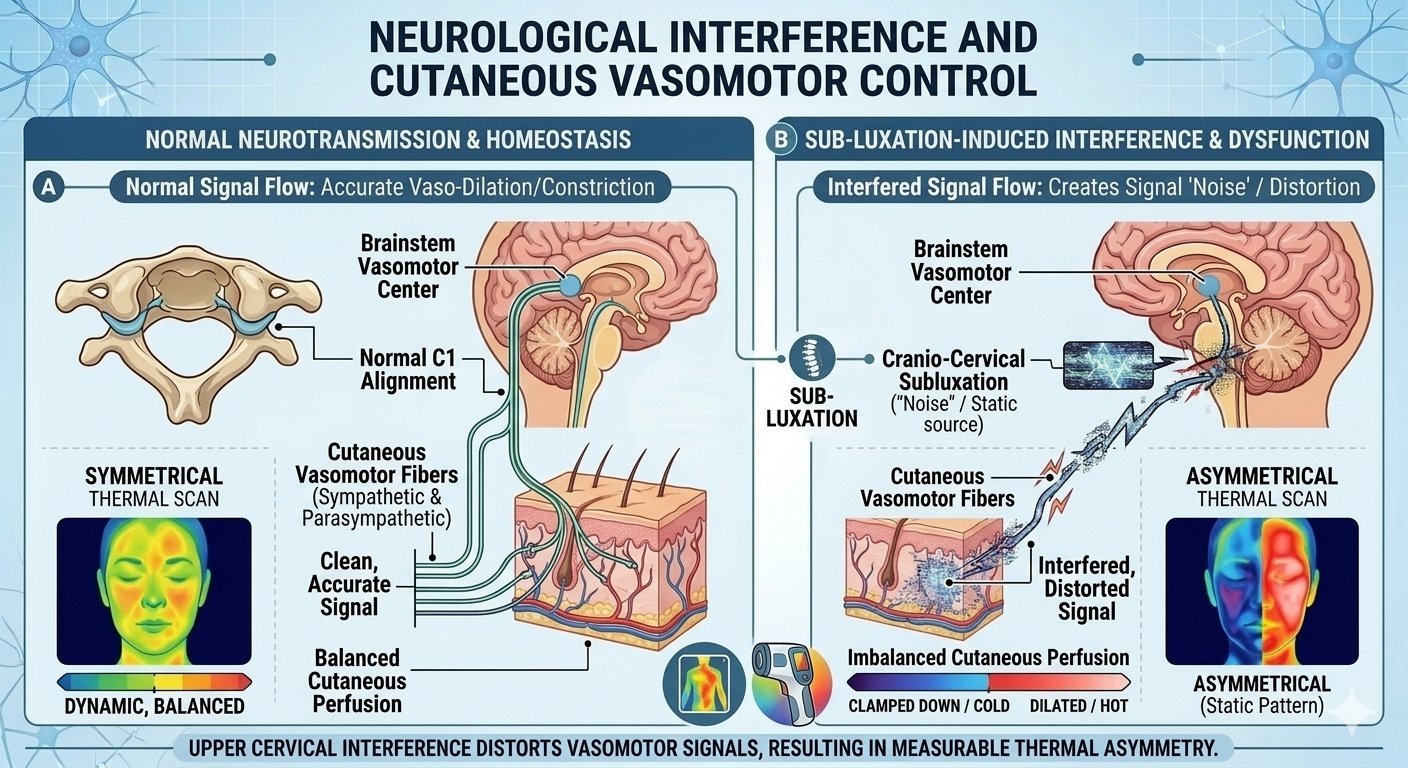
Chapter panel: Neurological Interference and Cutaneous Vasomotor Control, full version
From the chapter: Neurological Interference & Cutaneous Vasomotor Control.
Handout — Key Points The vasomotor chain: cord → sympathetic outflow → capillary resistance → skin temperature differential. Why thermography is a neurological examination, not a temperature reading.
Check — Patient-Language Drill Write your one-sentence explanation of subluxation for a new patient, then the sentence you say while showing them their scan.