Advanced HIO Toggle Recoil (Online) · Set 1 — Foundations

Lesson 1.3 — Craniocervical Junction & Listing Overview

No listing, no toggle.

Avatar Lesson Video — Render Ready, File Placement Pending

“Lesson 1.3. The Craniocervical Junction, and the Listing Overview.”

The Lesson

The anatomy this whole technique serves — atlas, axis, occiput as one functional unit — and what a “listing” is, before we learn to derive one in Set 2.

The Craniocervical Junction

Why the upper neck is neurologically privileged: everything between brain and body passes through one small junction — the brainstem descending through the foramen magnum, the vagal windows, and the dynamics of the cerebrospinal fluid. Interference here is never a local event; it is a whole-system event.
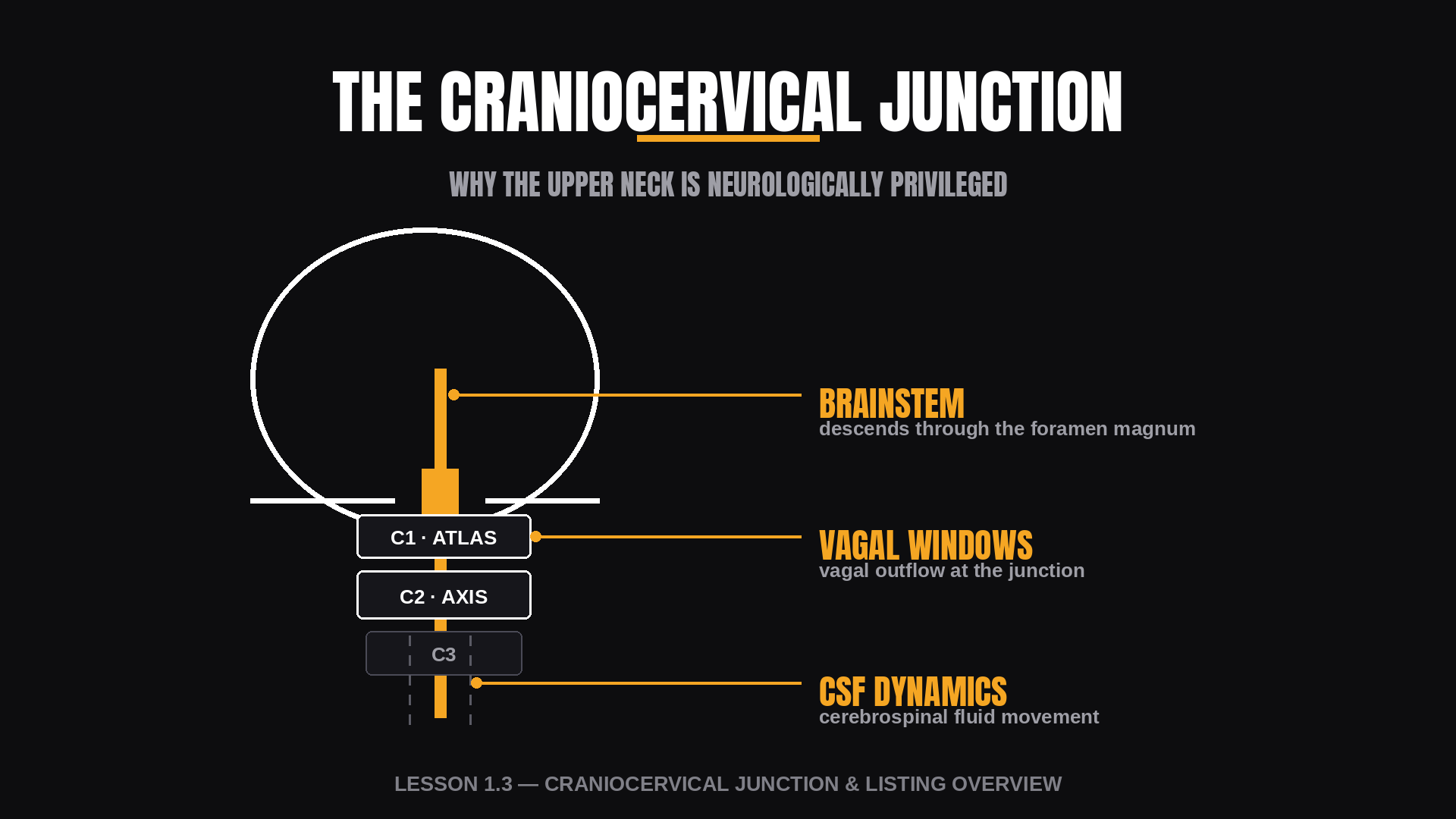
Side-view schematic of the skull, atlas (C1), axis (C2) and C3 with the brainstem descending through the foramen magnum, and three callouts: brainstem, vagal windows, CSF dynamics
Brainstem, vagal windows, CSF dynamics: why the upper neck is neurologically privileged.

Misalignment Patterns

Atlas/axis misalignment patterns commonly seen in practice: the pair sits centered, shifted, rotated, or shifted and rotated together. Recognizing the pattern is this lesson's work; deriving the listing from it is Set 2's.
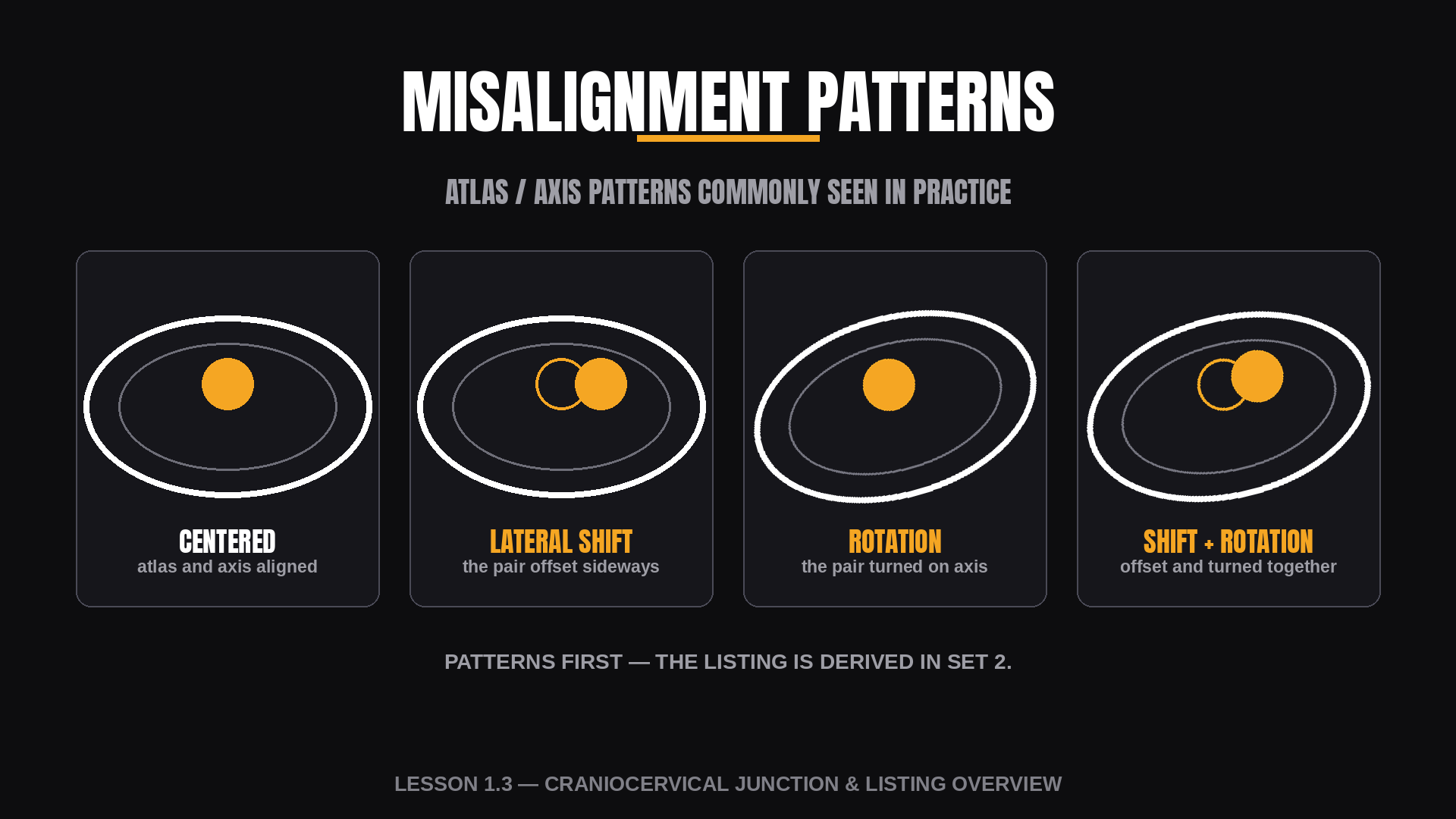
Four top-down schematic cards of the atlas-axis pair: centered (atlas and axis aligned), lateral shift (the pair offset sideways), rotation (the pair turned on axis), and shift plus rotation (offset and turned together)
Top-down schematics: the atlas/axis pair — centered, shifted, rotated, shifted and rotated.

The Listing

Listing = the positional diagnosis that dictates the vector. The listing is not a description of the pattern — it is the diagnosis the correction is built from. It resolves into one vector, one line of drive. No listing, no toggle.
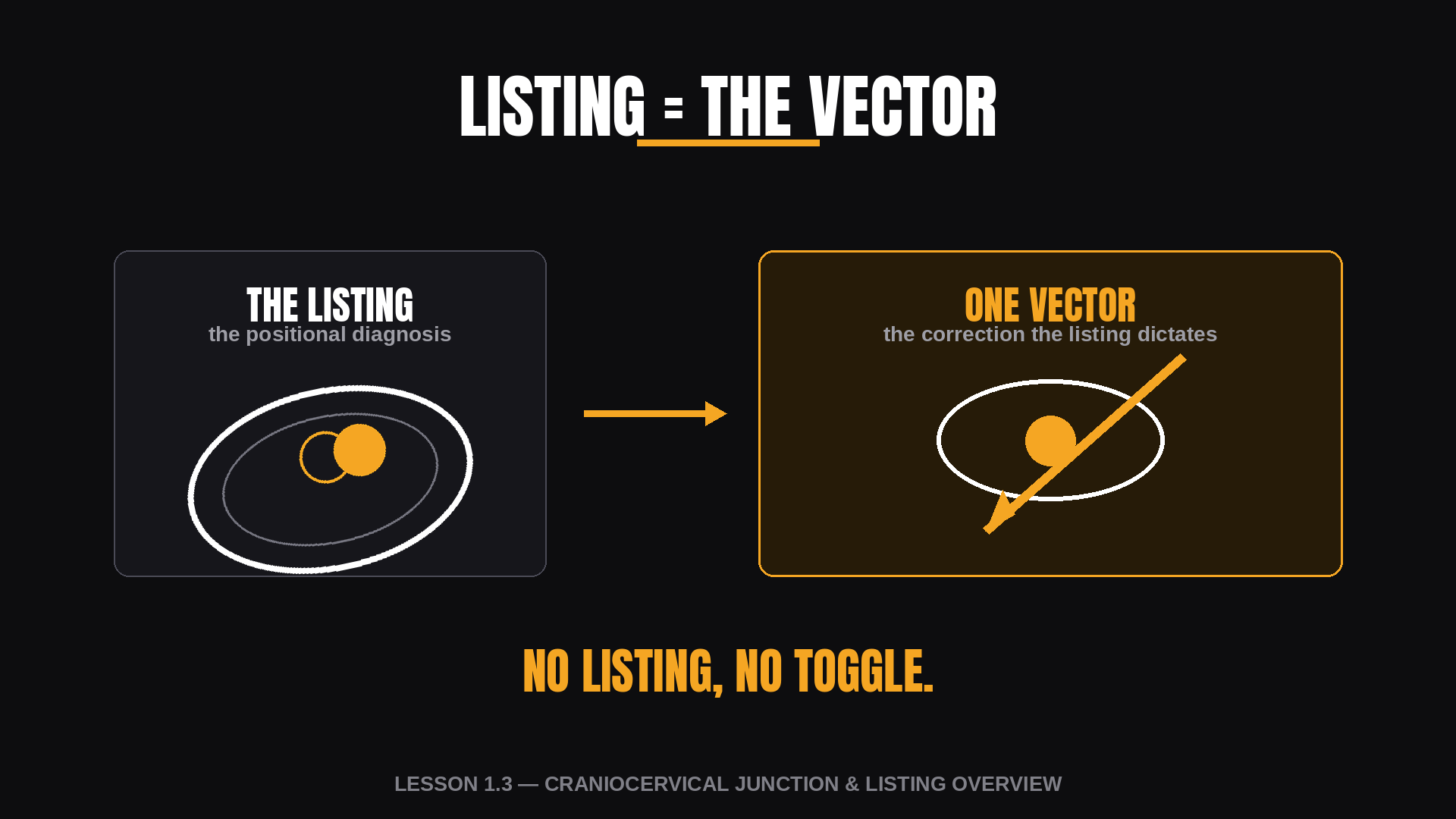
Diagram: the listing — the positional diagnosis, shown as an offset atlas-axis schematic — resolving through an arrow into one vector, a single orange drive line through the pair. Tagline: No listing, no toggle
The listing is the positional diagnosis; the vector is the correction it dictates.

How the Sets Connect

Foundations first — then the work divides cleanly: analysis finds it (Set 2), technique corrects it (Set 3), verification proves it (Set 4). Every later set assumes this lesson's anatomy and this lesson's definition of a listing.
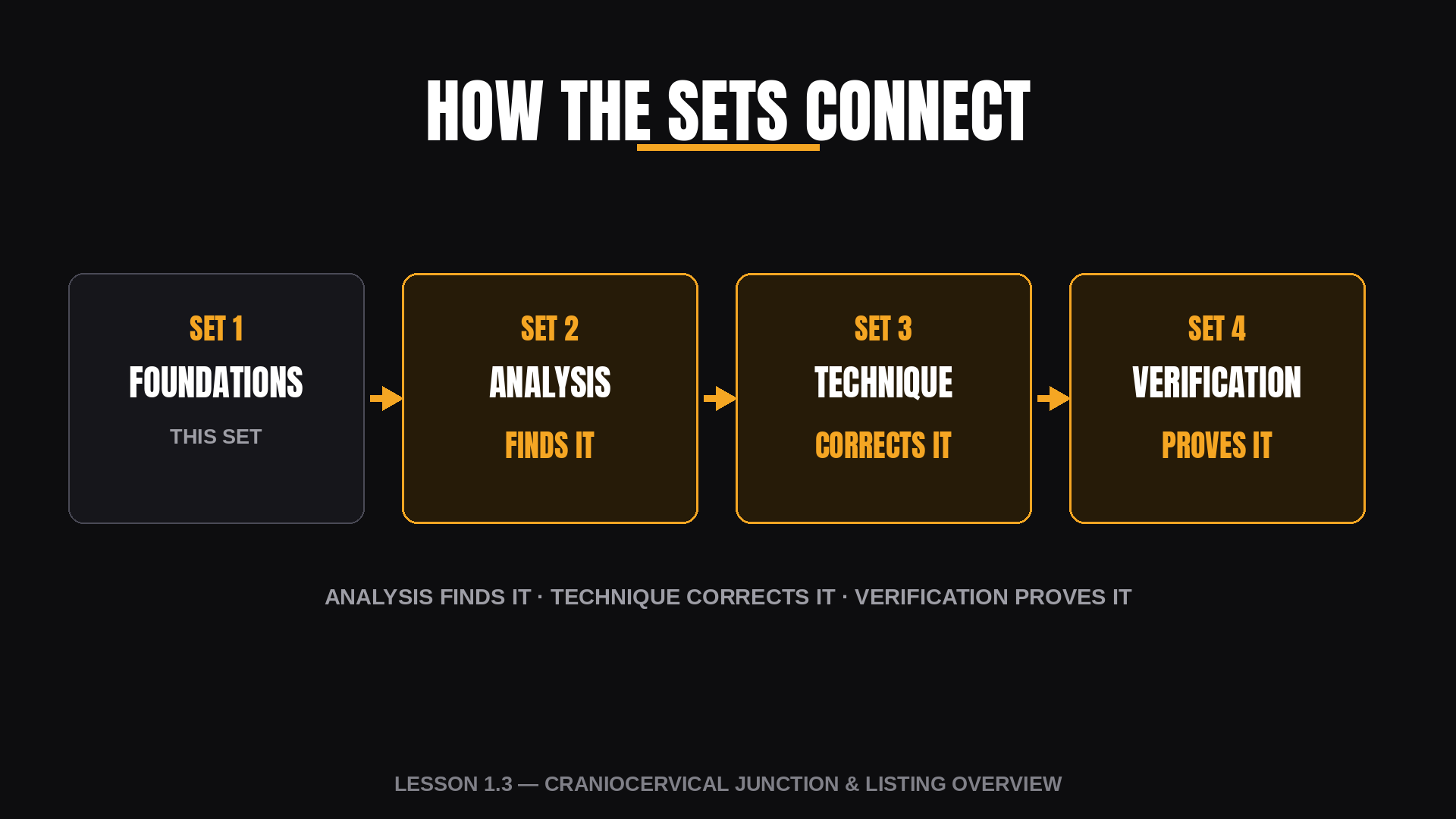
Four-block flow: Set 1 Foundations, Set 2 Analysis (finds it), Set 3 Technique (corrects it), Set 4 Verification (proves it)
Analysis finds it · technique corrects it · verification proves it.
Handout — Key Points Junction anatomy diagram notes; the misalignment-pattern glossary used throughout the course.